Saturday, September 6, 2014

From the archives....studio time

Mini Artist Residency
University of Illinois
an art teacher's journey into art making

This summer, I found a wonderful opportunity to go back to my roots, as an artist and art teacher....back to making art.  For a week, I immersed into materials, processes, techniques and reflection, all the while letting my self "play".  
I experienced a sense of fear at first.  The last time I had my own studio, my own time and my own space was, nearly, 11 years ago in the precious city of Venice, Italy.  For graduate school I worked, lived and breathed the encompassing notion of art. 
I made it.
I read it.
I explored it. 
I discussed it.
I ate it.
I drank it.
I fell in love with it  (and the people who became part of my life--love you.)

In the past 10 years, although my ideas were/are endless, they never transpired into something tangible....something real....something.  Art education became my life.  Not in the sense of living and breathing and becoming a hermit crab to the world, thinking only about my students, BUT teaching opened the door to other amazing opportunities, steering my focus away from making art.  Until this opportunity came around.
And thank goodness...I was beginning to develop a twitch.         
 Seriously.

So, what happened?

Well, for one week I sat for 10 hours in a studio and started painting, started drawing, started writing,  and started making incredible connections with some incredible people.  There were about 24 of us (?) who wanted nothing more than have uninterrupted time studio time. As a group, it seemed like we woke up together, we ate together, we created together and grew together.  Something magical happens when time and space are not a factor..

My week started off...small.  I have always seemed to float back to circles, ovals, orbs, spheres, playing with their shapes, and given them a sense of identity- Playful but somehow permanent.

I was, in reflection, focused on change and my ability to alter shapes, ideas, thoughts, motion and impression.


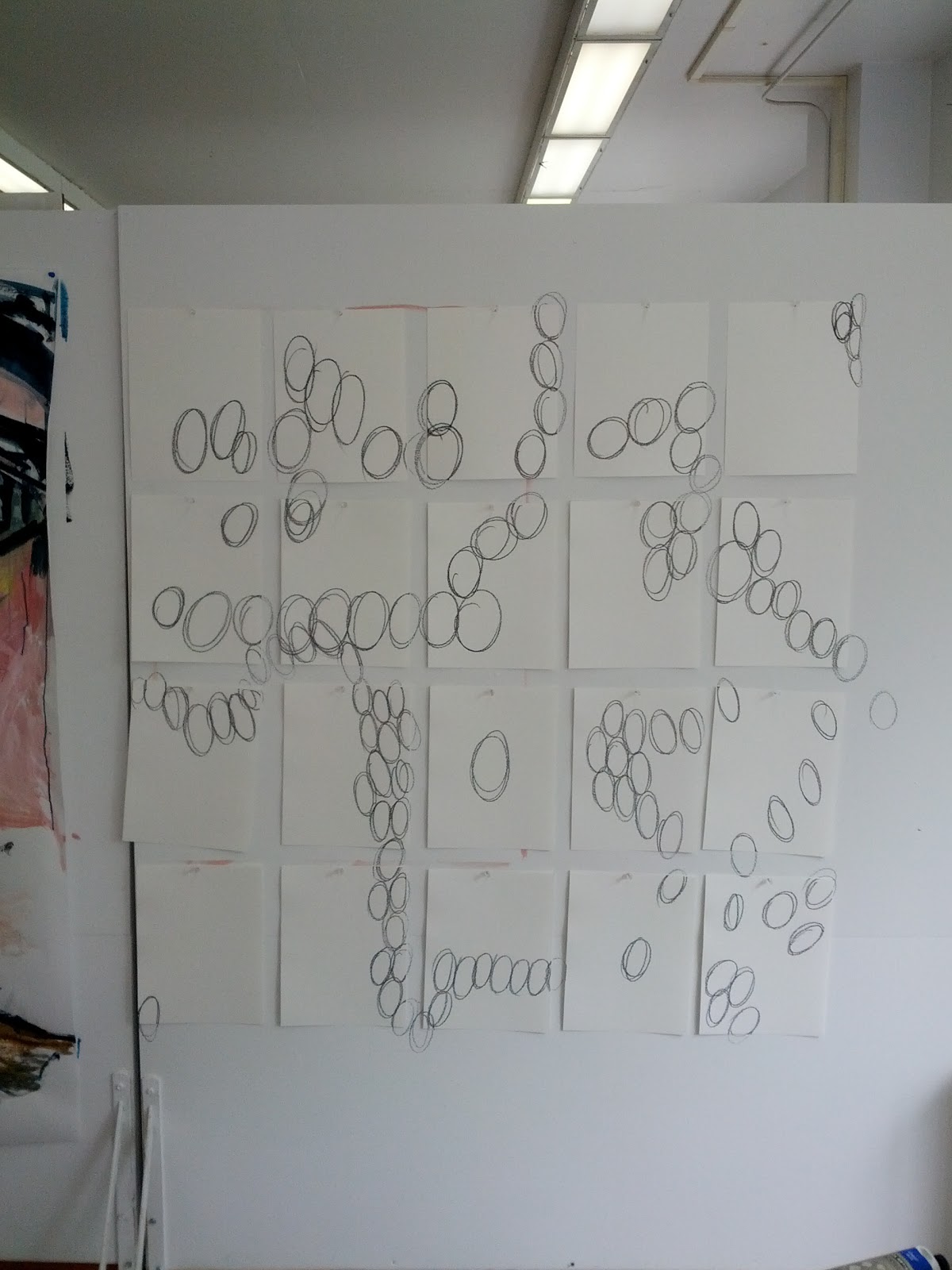


Throughout the week, I changed, altered and transformed my studio into different spaces, constantly moving from one idea to another...
But somehow they connected.

Floating shapes, colors and impressions connected one painting to another and one idea to another, linking my process throughout the week.

From small oval eye-ish shapes, I veered towards larger than life figure drawings of women, inspired by works of master artists.  If you look closely you may notice the pose of a Rembrandt, Matisse and Picasso.


By mid week, color and large surrounds changed to something more intimate and clean.  Sometimes, I feel to find inspiration and stay in the sweet spot of making art, you need to strip away everything and just work with simple, raw and organic processes.  
I felt good.


I, also, felt good to fall back into my comfort zone.  About ten years ago, as I was playing around with copper wire and gloss medium , I discovered something magical (well, at least to me).
A change.
 A transformation.


In an exciting farewell, our weeks work was displayed in a pop up art exhibit in a gallery.


My my new friends and colleagues....see you next year!


xoxo, SMocK you.
PS.  For more information: http://go.illinois.edu/microresidency

Saturday, August 30, 2014

Lessons from the archives...5th grade


So, life caught up with me back in the spring and posting came to a screeching halt.  To make up for slacking off, a bit, I offer some snapshots from my art lessons last spring.  It is really a few months ago, but with the new year starting, and as art teachers prepare their lesson plans here are some ideas....? :)
Or at least one.


 Understanding Modern Art by Connecting to Not-So Modern Art

5th grade students explored the world of Modern Art and tried to make some sort of sense of it.  This extensive and in-depth lesson started with looking at 18th-19th century American still life paintings.  They were beautiful, realistic and perfect.  Well...What happened?  In the early 20th century, a big art show made an enormous splash on the east coast, altering and questioning Art.  What changed?  Why?  Who?
These questions engaged my students' thinking and challenged their perception of art and paintings.  


My challenge was finding a way for my students to make connections and understandings.  We talked about and experimented with deconstructing a 'realistic' painting by using shapes, colors, lines and "blocking out".  This process really loosened up the students' thinking and eased them into seeing the elements of art appear out of nowhere and everywhere.


One of their experiments became their large scale paintings.  To add to their challenge, they were only to use paintbrushes.  This might sound silly, calling it a challenge, but consider how reliant students are on their pencils and erasers.  There is a sense of security with a tool that is erasable.  "Taking their pencils away" slowed their process and elevated their thinking, forcing each student to consider very carefully where that paint was going to go.
The artroom transformed into an art studio, in which students used every space possible to paint.  From tables, to easels, to the floor, students found their comfort zone.


The results were remarkable.


(lesson power point :-) )


More from the archives soon.
Have a great year!
xoxo, SMocK you.

Sunday, March 9, 2014

My Family Tree....2nd grade

"My mom cried when she saw it."....Jamese

After thinking about ourselves, we expanded our connection to the second target, Family.  This Art Unit was a wonderful exploration into discovering our roots and, sometimes, connections that we didn't even knew we had. 


The Art Unit's design and instructional sequence is multi-faceted, in which various scaffolded mini-lessons build towards achieving a culminating goal.  The overall goal was for students to develop their own art-making process through the development of an individualized sequence, resulting in a mixed-media art piece, representing their 'family tree'.  
Of course, along the way we needed to learn somethings, build on some skills and do some homework.  (It's no longer a surprise that homework for these little guys is repeated occurrence.) 

 For every target, I create a packet to help the students dig through the surface of the theme and really connect to the process.  I might seem like a lot of work (and it is) but this way, we don't just scratch the surface...we drill  a hole to get to the foundation.
The students started the lesson with a little bit of looking and investigating various paintings with with same theme: Trees, and answering questions that encouraged them to compare, contrast, describe and evaluate different styles and processes.  

For homework they had to ask their families for help, from drawing their families portraits to creating a 'web' showing how they connect to their entire families.  This portion of the lesson aimed for students and their parents to sit and talk about their families.


For my students to become more independent thinkers, I needed to create an activity that prompted their own knowledge of  the artistic process (at least the one we use in the art room).  I wanted them to make the choices and I wanted to see how they would organized their own project.  I showed them 3 different representations of trees and encouraged them to choose one as inspiration.  By choosing one, the students needed to take a step back and think how to execute a tree in a similar fashion.


It was their turn to show me "what you got!"


As the students chose their preferred style, they grouped around a dry-erase poster board with an image of the artwork.  As a group (and with much debate and arguing), they needed to figure out the steps needed to create the tree.  I wanted my students to demonstrate their background knowledge (the foundation of what we do with every project) by articulating the artistic process of decision making, problem solving, organizing, adapting and using art materials.


The rest was up to them....
I found my art room transform into 'their' art space.  I became their guide, as these Second graders took their art-making, their learning and their paths in to their own hands, and the results were fantastic.  


Follow the everyday activities of my students and my art room at our school Instagram page 
Sanborn_Smockroom

As always, thanks for dropping by 
and see you soon in the 
SMocKroom

xoxo, SMocK you.