Showing posts with label 5th grade. Show all posts

Thursday, November 19, 2015

IAEA Conference 2015

Professional Development 
at its 
Best

Every year I attend and present at the annual Illinois Arts Education Association Conference.  And every year, I am revived and recharged by the amazing two days.

This year, I shared a lesson I created for my 5th grade students using styrofoam cups:
http://smockroom.blogspot.com/2015/05/ordinary-to-extraordinary.html

Here are some snapshots from the workshop.


This engaging art unit incorporated drawing, painting, sculpting and photography!
Thank you to all the participants for their energy and enthusiasm.

xoxo, Smock you.


Sunday, June 7, 2015

Is art important?

"How she made the holocaust a unit for art"--5th grade student responding to "What did you like".

Towards the end of each year, the 5th grade curriculum prompts teachers to focus on the Holocaust, a necessary and important topic.  Every year, I integrate their classroom experience with some sort of art lesson, from illustrating poems written during that era or creating 1,000,000 butterflies in memory of the kids who died durning that time.
Although we were making art and learning aspects of history, there was not a great synergy of the two subjects.  
Until now.
And why it has taken me so long, I can not say.
But.
Until now.

I am guessing...but sometime in the fall, I finally got around to watching "Monuments Men", a movie based on the true story of the special task forced, assembled by President Dwight D. Eisenhower during World War II to protect cultural artifacts and artworks being destroyed and/or looted by Nazi forces.  Yes, this was a Hollywood movie but the based of the film prompted me to rethink the end of the year art unit for my 5th grade students.

I thought.....well, I thought a lot of things...BUT I ended up with a discussion about the impact on cultural and world history, and Adolf Hitler's perspective of Modern Art.

With a little (really a lot) of research, I ended up creating a lesson based on "Degenerate Artists".  Along the way, I discovered great resources including


The website address is deceiving.  It is actually a wonderful resource for educators.
In designing and re-designing this art unit, I paused at the enormity of this topic and the relevance in today's world events.  It seemed extremely important to me, for my students to see past their 'school world' and see the rest of the world, good and bad.

The art unit goal was simple:
Recreate an artwork, originally created by an artist labeled "Degenerate" and formulate a reflective response to "Is Art Important?"  (in 4 weeks)

I was really blown away with what my students achieved.  They considered, carefully, what medium would help them achieve the most accurate results, but only after considering their own individualized abilities.  It was liberating and refreshing to let these 5th grade students make their own choices.  Each of them started their piece with a bit hesitation and uncertainty, but by the end, their was nothing but confidence and pride. 
A great feeling by all.


Horse in a Landscape, 1910, by the German Expressionist
Franz Marc, denounced by the Nazis as a "degenerate" artist.


JANKEL ADLER, BIRD, 1944


And in the end, we did answer the question.
Yes.
Art is Important.
It's our history, our culture, our world
 that helps us understand 
who we are, 
where we came from 
and 
where we are going.

xoxo, Smock you.

Monday, May 18, 2015

Ordinary to Extraordinary....

The Evolution of a Styrofoam Cup
About a month ago, I came across a Pinterest post (I think) of the DC Sketchers, with the related image of a group of people, gathered around a small table, 
sketching a still life of styrofoam cups.  
I thought, "Oh how fun"!
I then proceeded to think about my students perceptions of common objects and their inherent nature to "know things", just by having some sort of experience with them.  Take the simple styrofoam cup for example.  This simple vessel is used everyday, from the coffee cups at school functions to quenching the thirst of miniature soccer players, to 'pots' that will soon grow beans in our classrooms.  
They are everywhere and by being everywhere, these familiar objects become common and common leads to inattentiveness.
And then I thought, again, "Oh this WILL be fun"!

In preparation for this art unit, I reflected on the numerous art installations I found on Pinterest and Scholastic Art Magazine, created by this very simple object.  With a little 'Googling', I came across Styrogami.  Yes, it's an actual thing and it is AMAZING (Check it out Here)
But my focus was not just to make a really cool sculpture, my focus was to encourage my students to pay attention to details and 'see' how a simple curve can transform something flat into something with volume.  I wanted my students to analyze materials and evaluate their effectiveness when using them.  I wanted my students to see how even simple shapes can be transformed into something bigger and magical.  
I wanted my students to see how something ordinary can become extraordinary, and how something seemingly simple is, in reality, complex.

Throughout this school year, I have been focusing on creating art units that 'test' my students' skills but also demonstrate their growth to them, fostering an understanding for process over product.  After all, how much can we possibly do with a styrofoam cup?  
My overall focus was for students to understand the 'process' of making art, is as important, if not more important than the product.  To illustrate this idea, I referred to the artist Richard Serra.
My speculations were pretty accurate.  To begin the unit, I simply passed out some manilla paper, asked the students to fold it in half, write their name and "Perceptions of Space" on the cover and then draw a styrofoam cup.
With cups already on the table, my confident students took the challenge with full force and began to vigorously draw a styrofoam cup.  I heard, "This is easy" and "I'm done" very often, all the while taking note that the majority of these, very confident, students were not even looking at the cups.  


After stopping them, we took a little gallery walk around the room and evaluated our peers' efforts.  There were a lot of groans.....
My first question was "Does it look like a styrofoam cup?"
The majority offered their responses with a "eeehh...."
Then I asked, "Did you look at the cup?"
The majority offered a "eeeehhhh..."
Then I asked, "Why not?"
"Because it's just a styrofoam cup".


I offered, "Aaaah".
Let's try this again.

The entire instructional sequence spanned 8 weeks (probably more) but you never would have thought it, with all the interest and sheer will to master drawing a cup.  We started with simple line drawings and progressed to larger abstract paintings...to styrofoam cup sculptures...to photography...and back to a simple cup.
All the while building our observational drawings skills, visualization skills, problem solving skills and reflective skills.  
Pretty amazing stuff.
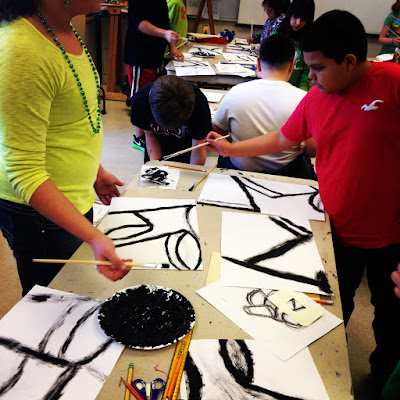


Check out the rest of the snapshots
and the entire Art Unit with "I Can" statements, rubric and discussion sequence!

Follow on our Instagram page:
sanborn_smockroom

xoxo, Smock Room


Saturday, August 30, 2014

Lessons from the archives...5th grade


So, life caught up with me back in the spring and posting came to a screeching halt.  To make up for slacking off, a bit, I offer some snapshots from my art lessons last spring.  It is really a few months ago, but with the new year starting, and as art teachers prepare their lesson plans here are some ideas....? :)
Or at least one.


 Understanding Modern Art by Connecting to Not-So Modern Art

5th grade students explored the world of Modern Art and tried to make some sort of sense of it.  This extensive and in-depth lesson started with looking at 18th-19th century American still life paintings.  They were beautiful, realistic and perfect.  Well...What happened?  In the early 20th century, a big art show made an enormous splash on the east coast, altering and questioning Art.  What changed?  Why?  Who?
These questions engaged my students' thinking and challenged their perception of art and paintings.  


My challenge was finding a way for my students to make connections and understandings.  We talked about and experimented with deconstructing a 'realistic' painting by using shapes, colors, lines and "blocking out".  This process really loosened up the students' thinking and eased them into seeing the elements of art appear out of nowhere and everywhere.


One of their experiments became their large scale paintings.  To add to their challenge, they were only to use paintbrushes.  This might sound silly, calling it a challenge, but consider how reliant students are on their pencils and erasers.  There is a sense of security with a tool that is erasable.  "Taking their pencils away" slowed their process and elevated their thinking, forcing each student to consider very carefully where that paint was going to go.
The artroom transformed into an art studio, in which students used every space possible to paint.  From tables, to easels, to the floor, students found their comfort zone.


The results were remarkable.


(lesson power point :-) )


More from the archives soon.
Have a great year!
xoxo, SMocK you.