Tuesday, June 9, 2015

My Art Adventure...


Throughout the year, first grade students venture in the amazing story of Anna and her quest to find the toilet in Anna's Art Adventure.  It's a remarkable story of adventure, mystery and urgency.The story introduces my students to artists and their styles, with quirky references and a red dress.  

A few of weeks ago, I filled a couple of buses with 6th graders and headed to the Art Institute of Chicago for their annual art field trip.  Along with jumping (or trying to jump-the AIC is a big place) from group to group, I snapped photos of some very important art works... at least to my 1st graders...

Such as the hunt to find the toilet, my quest was to find the artworks and artists Anna encounters on her search.

Luckily, my hunt lasted about 20 minutes as apposed to the 9 months my first graders had to endure.

Here is My Art Adventure in the 
Art Institute of Chicago:


Ellsworth Kelly 


Rembrandt van Rijn


Edvard Munch


Piet Mondrian


 Vincent van Gogh


Pablo Picasso


 Insert Andy Warhol HERE.  


 Rene Magritte


Marc Chagall


Paul Cezanne


Henri Matisse


Jackson Pollock


Marcel Duchamp


Salvador Dali


Mrs. Angelopoulos

Because when you've gotta go...

Check out the full 1st grade curriculum, with a complete power point presentation.

xoxo, Smock Room.

Sunday, June 7, 2015

Is art important?

"How she made the holocaust a unit for art"--5th grade student responding to "What did you like".

Towards the end of each year, the 5th grade curriculum prompts teachers to focus on the Holocaust, a necessary and important topic.  Every year, I integrate their classroom experience with some sort of art lesson, from illustrating poems written during that era or creating 1,000,000 butterflies in memory of the kids who died durning that time.
Although we were making art and learning aspects of history, there was not a great synergy of the two subjects.  
Until now.
And why it has taken me so long, I can not say.
But.
Until now.

I am guessing...but sometime in the fall, I finally got around to watching "Monuments Men", a movie based on the true story of the special task forced, assembled by President Dwight D. Eisenhower during World War II to protect cultural artifacts and artworks being destroyed and/or looted by Nazi forces.  Yes, this was a Hollywood movie but the based of the film prompted me to rethink the end of the year art unit for my 5th grade students.

I thought.....well, I thought a lot of things...BUT I ended up with a discussion about the impact on cultural and world history, and Adolf Hitler's perspective of Modern Art.

With a little (really a lot) of research, I ended up creating a lesson based on "Degenerate Artists".  Along the way, I discovered great resources including


The website address is deceiving.  It is actually a wonderful resource for educators.
In designing and re-designing this art unit, I paused at the enormity of this topic and the relevance in today's world events.  It seemed extremely important to me, for my students to see past their 'school world' and see the rest of the world, good and bad.

The art unit goal was simple:
Recreate an artwork, originally created by an artist labeled "Degenerate" and formulate a reflective response to "Is Art Important?"  (in 4 weeks)

I was really blown away with what my students achieved.  They considered, carefully, what medium would help them achieve the most accurate results, but only after considering their own individualized abilities.  It was liberating and refreshing to let these 5th grade students make their own choices.  Each of them started their piece with a bit hesitation and uncertainty, but by the end, their was nothing but confidence and pride. 
A great feeling by all.


Horse in a Landscape, 1910, by the German Expressionist
Franz Marc, denounced by the Nazis as a "degenerate" artist.


JANKEL ADLER, BIRD, 1944


And in the end, we did answer the question.
Yes.
Art is Important.
It's our history, our culture, our world
 that helps us understand 
who we are, 
where we came from 
and 
where we are going.

xoxo, Smock you.

Saturday, May 23, 2015

Art Teachers Playing Around...


About a month ago, three art teachers packed up a Subaru and headed to 
Southern Illinois University-Edwardsville for the annual Art Education Conference.

And it was fabulous.  

We talked, just about everything on the ride down, and sang to our hearts out, on the way home but before that we were leaders.  We held workshops and presentations.  We shared our accomplishments, techniques, lessons, ideas, email addresses and we felt a community start to grow.
It was invigorating discussing art education trends, theories, philosophies...
It was fabulous.
But on the first hot day of the season and as the trees were in full bloom, 
the most fabulous time was when we paused.
I sat with one of the most energetic, driven and passionate art teachers (yes, you Jil) and sat....
I sat
and enjoyed a cup of coffee, outside, in the sunlight.


We took off our shoes, and it felt good.  We took a walk and just talked about...well...everything.
As we walked through the campus we came across an amazing sculpture, constructed out of big bold colorful Lego blocks, titled:
The Importance of Play


This sculpture steered our conversation towards our own art-making and the issue of "playing around".

As art teachers, we thought, "how often do we gather to just make art?" 
Not for samples in our classrooms, not to engage in a discussion about practice, not to collect our professional development credits....
but to just make art.
...to just be in a space with individuals who inspire creativity, think big and laugh a lot.


Not very often.  In fact prior to this conference I held a workshop for art teachers at my school, in which I had planned the activities as to show that this is a 'valid professional development experience' (said in a very serious voice).
Yet, I threw my plan out the window because I realized we (the collective participants) didn't need another lesson at 5 o'clock on a Thursday evening.  They needed to pause, to have a slice of pizza and to play.


It felt really good.


 So, take 20 minutes to play:
doodle
paint
draw
color
sculpt

Anywhere and everywhere.

I did and I ended up like this:

...and made something like this...


xoxo, Smock you.

Following the Smock Room...


I am super excited to see so many people reading my posts!
The best way to keep up with what is happening in the Smock Room is by checking out sanborn_smockroom.

It's a daily feed on the daily activities in my classroom!


Thanks a bunch!

xoxo, Smock Room.

Monday, May 18, 2015

Ordinary to Extraordinary....

The Evolution of a Styrofoam Cup
About a month ago, I came across a Pinterest post (I think) of the DC Sketchers, with the related image of a group of people, gathered around a small table, 
sketching a still life of styrofoam cups.  
I thought, "Oh how fun"!
I then proceeded to think about my students perceptions of common objects and their inherent nature to "know things", just by having some sort of experience with them.  Take the simple styrofoam cup for example.  This simple vessel is used everyday, from the coffee cups at school functions to quenching the thirst of miniature soccer players, to 'pots' that will soon grow beans in our classrooms.  
They are everywhere and by being everywhere, these familiar objects become common and common leads to inattentiveness.
And then I thought, again, "Oh this WILL be fun"!

In preparation for this art unit, I reflected on the numerous art installations I found on Pinterest and Scholastic Art Magazine, created by this very simple object.  With a little 'Googling', I came across Styrogami.  Yes, it's an actual thing and it is AMAZING (Check it out Here)
But my focus was not just to make a really cool sculpture, my focus was to encourage my students to pay attention to details and 'see' how a simple curve can transform something flat into something with volume.  I wanted my students to analyze materials and evaluate their effectiveness when using them.  I wanted my students to see how even simple shapes can be transformed into something bigger and magical.  
I wanted my students to see how something ordinary can become extraordinary, and how something seemingly simple is, in reality, complex.

Throughout this school year, I have been focusing on creating art units that 'test' my students' skills but also demonstrate their growth to them, fostering an understanding for process over product.  After all, how much can we possibly do with a styrofoam cup?  
My overall focus was for students to understand the 'process' of making art, is as important, if not more important than the product.  To illustrate this idea, I referred to the artist Richard Serra.
My speculations were pretty accurate.  To begin the unit, I simply passed out some manilla paper, asked the students to fold it in half, write their name and "Perceptions of Space" on the cover and then draw a styrofoam cup.
With cups already on the table, my confident students took the challenge with full force and began to vigorously draw a styrofoam cup.  I heard, "This is easy" and "I'm done" very often, all the while taking note that the majority of these, very confident, students were not even looking at the cups.  


After stopping them, we took a little gallery walk around the room and evaluated our peers' efforts.  There were a lot of groans.....
My first question was "Does it look like a styrofoam cup?"
The majority offered their responses with a "eeehh...."
Then I asked, "Did you look at the cup?"
The majority offered a "eeeehhhh..."
Then I asked, "Why not?"
"Because it's just a styrofoam cup".


I offered, "Aaaah".
Let's try this again.

The entire instructional sequence spanned 8 weeks (probably more) but you never would have thought it, with all the interest and sheer will to master drawing a cup.  We started with simple line drawings and progressed to larger abstract paintings...to styrofoam cup sculptures...to photography...and back to a simple cup.
All the while building our observational drawings skills, visualization skills, problem solving skills and reflective skills.  
Pretty amazing stuff.
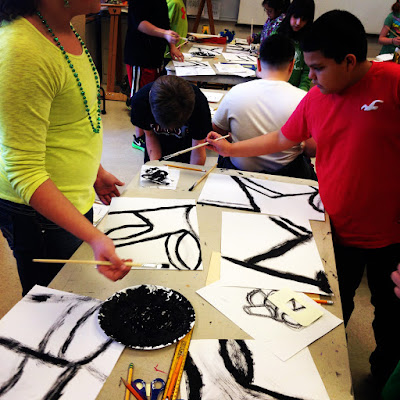


Check out the rest of the snapshots
and the entire Art Unit with "I Can" statements, rubric and discussion sequence!

Follow on our Instagram page:
sanborn_smockroom

xoxo, Smock Room