Tuesday, December 1, 2015

Traveling without Moving...

To Ghana
with Yianna and Helios

Our most recent 3rd grade adventure has taken us to the vibrant country of Ghana, following the exciting discoveries of Yianna and Helios (two precarious 3rd grade friends who travel the world).

My 3rd grade students enthusiastically await for emails and letters from these two friends in discovering where in the world we land next, in our art adventure.  This time we landed on the continent of Africa and in the country of Ghana.

This art unit focused on the art and culture of Ghana, particularly the folk traditions of Kente Cloth. The art unit was broken down into 3 components in which students explored, created and reflected on the tradition and process of Kente Cloth.

Exploring:  With every travel adventure, we take a day (or so) to explore the specific country by reviewing and understanding the cultural and historical components that make each country unique.  Throughout this unit, we were building our knowledge towards answering the essential question of "How do artists use the cultural context to communicate an idea?"  Knowing the context, students begin to develop a better understanding of purpose and meaning, connecting their knowledge to their artmaking.    Along with the historical and cultural references, we listened to the story of "The Spider Weaver", telling the legend of how and why Kente Cloth is an important component to the people of Ghana.

Creating:  The instructional sequence of this unit focuses on the creation of a "Kente Cloth".  But that did not seem interesting enough;-)
The overarching goal was "By investigating the art and culture of Ghana’s Kente Cloth, students will demonstrate their understanding of color symbolism by creating a personalized “Kente Cloth” using art elements and principles (color, lines, shapes, repetition), and reflecting on their personal characteristics."  Students referenced a list of colors and associated their description with their own unique personalities, choosing four.  This creating process afforded the students to practice their measuring skills and just the challenging feat of holding a ruler straight.  The students created 3 different patterns to use within the larger creation of their Kente Cloth, filling them in with the 4 personal colors.


Reflecting:  The final component asked students to think about their choices and connect their personal understanding to the symbolic representation of color in Ghanaian culture.  Simply, the students completed 4 sentence prompts expressing how they express their chosen colors.  (I am BLUE, because I show LOVE when I HUG MY BABY BROTHER). 
This was a quick art adventure.  The instructional sequence lasted about 3 days with my students working swiftly and often in helping each other.  Check out the few of many snapshots below and follow my students daily activities on Instagram.  If you are interested in the full lesson, with printables and more resources click HERE.


Thanks for dropping by!
xoxo, Smock You.

Sunday, November 22, 2015

Showing STEAM with Frank Stella...

Celebrating a lifetime of work
with a little bit of STEAM

Frank Stella, 1964, photo by Ugo Mulas
It is an exciting time to visit the Whitney Museum in New York City.  To begin with, the Whitney opened its doors in a new location and an amazing new building this year, bringing along the lifelong, trans-formative work of Frank Stella.

In my art class, I found this the perfect opportunity to inspire my students with Stella's early work, emphasizing a steady hand and protractors.

Along with my student teacher, we developed a lesson that challenged the students to transform a familiar analytical tool in their artwork, referencing the ideas and work of Stella.

The Venn Diagram

Frank StellaFiruzabad, 1970 https://www.sfmoma.org/artwork/2002.9
I use Venn diagrams a lot in art class as tools for my students to organize their thoughts when analyzing artworks throughout our learning process.  These simple interconnected circles became the center of attention but in a different way.  

Along with the Retrospective of Frank Stella, November 19th, 2015 marked an incredible day for Arts Education:

In the midst of the biggest shakeup of federal education law in over a decade, Congresswoman Suzanne Bonamici 
(D-OR) successfully added an amendment today to the rewrite of the nation’s Elementary and Secondary Education Act (ESEA) legislation that will integrate the arts into STEM education (science, technology, engineering and math).
Art is CORE:)

"Frank Stella's 'Harran II', 1967". Licensed under Fair use via Wikipedia 
Art is a CORE subject in developing our young peoples into creative and innovative problem solvers, bringing new perspectives, ideas and solutions to, what used to be, the fundamentals of education.

It is about time.

This art unit, not only studied the work of Frank Stella, but demonstrated to my students that fine artists, like architects, designers and....doctors, all use tools to achieve the best outcome and precision, steady hands and accuracy are important attributes.

The instructional sequence was developed within a three week time frame for 4th grade (seeing the students once a week for one hour).


DAY ONE:  Investigate Frank Stella's "Protractor Series", focusing on the elements, techniques and attributes that made Stella's work special. (Shape, color, line, overlapping, precision, big)  Allow the students a little bit of "play time".  Although the students may be familiar with using a protractor, anticipate their challenges:  moving the protractor, making lines to dark, moving the protractor too little...  This time, also, helps the students evaluate their own skills and what to do to achieve their best outcome.


DAY TWO:  Designate the second day for a quick review of the day before.  My students were given a homework assignment, in which they were to compare and contrast Firuzabad with a work by Kandinsky using a Venn Diagram.  After a group discussion, I demonstrated a process of transforming the Venn Diagram into something extraordinary.  I emphasized the process of overlapping to be simple and visually to appear consistent.  Erasing the overlapping shapes demonstrated to be a consistent challenge, but students found their way to working through the problem.


DAY THREE:  The last day focused on choosing a color scheme and piecing together our drawings with color.  I took the time to demonstrate using our color choices to complete our designs, emphasizing overlapping by deciding whether colors will "go over, or under" each other.  There was sense of hesitation at this stage in the project because the students expressed their confusion amongst all the intersecting lines.  BUT...it, really, all came together for them when they were filling in their colors.


The results were fantastic!  Most importantly, the students felt proud about what they accomplished.


These are just a couple of examples.  More of my students work (and works in progress) can be seen at

The resources and complete lesson is available HERE :)

xoxo, Smock you.

Thursday, November 19, 2015

IAEA Conference 2015

Professional Development 
at its 
Best

Every year I attend and present at the annual Illinois Arts Education Association Conference.  And every year, I am revived and recharged by the amazing two days.

This year, I shared a lesson I created for my 5th grade students using styrofoam cups:
http://smockroom.blogspot.com/2015/05/ordinary-to-extraordinary.html

Here are some snapshots from the workshop.


This engaging art unit incorporated drawing, painting, sculpting and photography!
Thank you to all the participants for their energy and enthusiasm.

xoxo, Smock you.


Sunday, November 15, 2015

First Grade and Ellsworth Kelly

Exploring Shapes and Colors 
with 
Ellsworth Kelly
in First Grade
First grade brings a wonderful sense of exploration and play to the art room.  These young students are eager to manipulate materials and seek out answers.  They bring a great energy to the room every week.  An on going theme throughout the year, is exploring various artists by following the story of Anna's Art Adventure.  
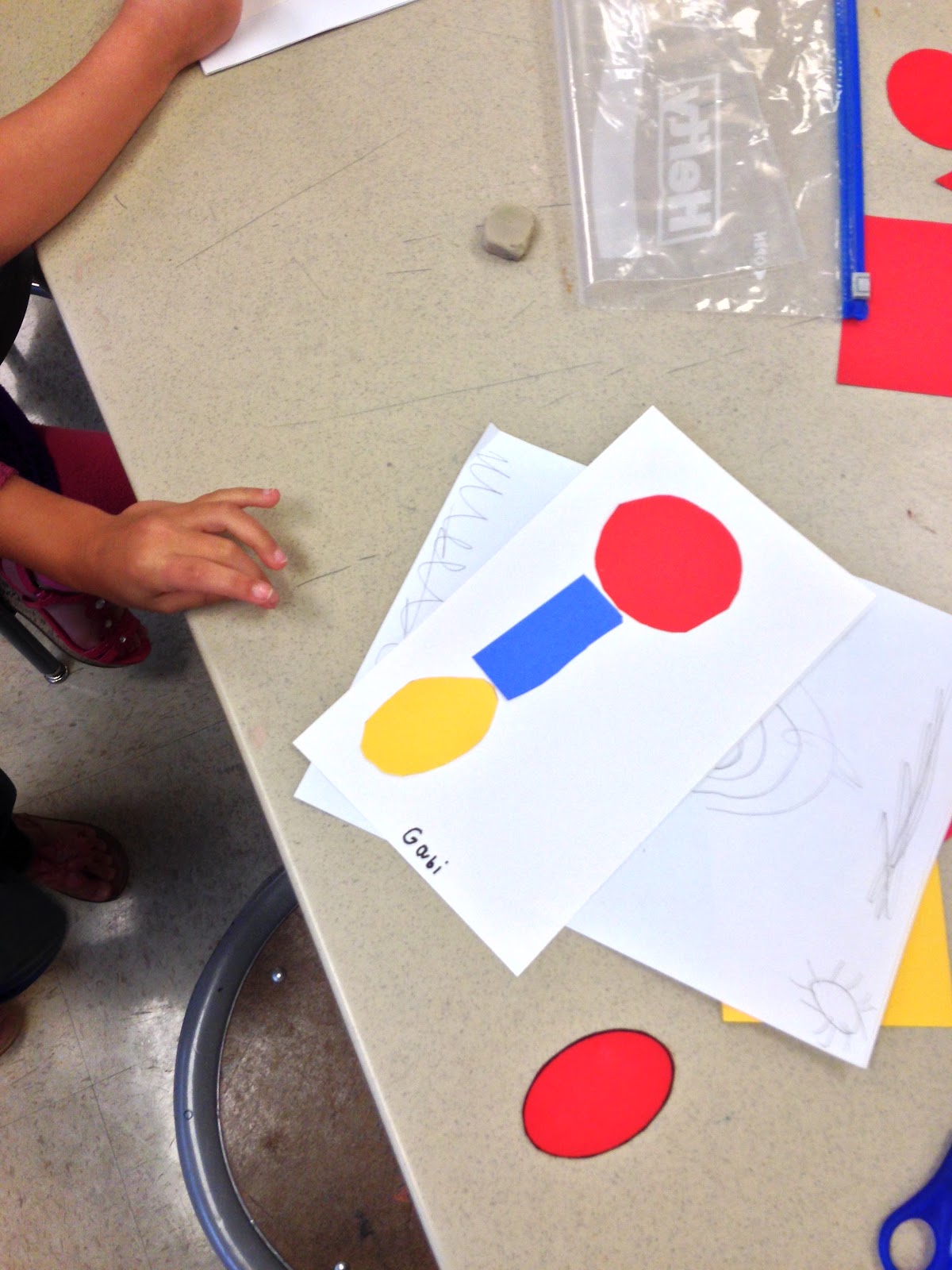
With adventure books in hand, we start with the work of contemporary artist Ellsworth Kelly with his simple, yet grand shapes and colors.  
The instructional sequence allows the students to play and explore geometric shapes and primary colors, using few methods of learning.  The year long goal for these young students is them to develop the initial skills and vocabulary in their art-learning and art-making.
For this particular lesson, the goal was for students to demonstrate their understanding of these simple shapes through identification, description and production.
The process was, also, my way of learning more about these students individual needs, their individual skills and their level of development in regards to introductory skills, such as, tracing, cutting, 
coloring, and painting.  
(After all, they are 6 years old and this is their first formal art education class.)
These snapshots illustrate the instructional sequence.  The sequence offered my students opportunities to explore, play and create, while building analytical skills, fine motor skills and art vocabulary.


Thanks for dropping by.
For the lesson click here:)

xoxo, Smock Room


Monday, September 21, 2015

Cheers....

to the Good Days....


As teachers, we are on constant roller coasters that wind, whip, creep, climb, drop and loop throughout the years. 
 Some years never seem to end, while some years in a blink, they are done.
Some years are one challenge after the other, while other years are full of sense of achievement.
Some days you wonder if you did anything that mattered to any student, while other days you receive a glimpse of something that mattered.  
Today was one of those days.
While shuttling off students, after school, to their various modes of transportation, one student came up to me and asked me why I did not teach his class this year, "I miss you", he said. 
Due to our school's growing population, their is another art teacher that instructs 2 classes. 
 I explained to him the reason and then asked him "why"?
"She doesn't teach like you do", he said with a subtle whine.
:)
There hasn't been a smile on my face the entire time of my teaching career but I can say that today,
"I'm still smiling".


xoxo, Smock You.

Friday, September 18, 2015

modern twists....

Looking at the Art of Suzan Shutan....
in second grade

A component to the second grade curriculum engages my students in the theme of community.  Much needed, this theme builds on several important and vital skills in today's world:  cooperation and collaboration.

All that is great but we are dealing with 8 year olds.  Engagement and interest are key elements for creating an environment for 2nd graders to build and grow these skills.  They also need to feel like it is fun.

As their art teacher, I search out new  and exciting artists that will capture the attention of these wonderful students, while "teaching them a lesson".  I came across Suzan Shutan in my search (I can't remember if it was on Pinterest or just a Google search-but I found her).  She is an installation artist!  How often do you use one of those in your classroom?

I was inspired to by her Tar Roofing Paper installations in which thousands of paper are looped to created wonderful undulating designs across walls, floors and ceilings.

I thought to myself, "Well, isn't this just perfect".
"What if all 2nd grade students worked collaboratively towards creating large hanging paper installations in the style/work of Suzan Shutan?"

And that is what we did.


Along the way we had to learn something and along the way we had to use some critical thinking skills.  I created a "sub-lesson" (meaning a lesson within a lesson) for my students to look beyond just rolling paper and explore these installations with an imaginative, exploratory eye (or eyes).

In connection with Suzan Shutan's modern work, I introduced my students to the folk art of quilling.  We looked at the process of quilling in comparison to the process of Suzan Shutan.  With many different examples, we focus on a more contemporary approach to the folk art and reflected on different ways to combine the two.


The results were magical.
Groups of students worked very diligently for an hour, rolling a gluing strips of pre-cut, colorful construction paper.  Everybody had a role, and everybody lent a hand.

These wonderful installations were hung in our school's hallways, receiving amazing reviews by staff, parents and students.


Find the lesson here:)

xoxo, Smock Room